
Local SEO for tree service companies is how you show up when someone in your town searches for tree removal or trimming or emergency storm work. That’s it. It’s not some magical thing. You optimize your website and your Google presence so people actually find you when they need a tree company.
Most tree service owners we work with have never touched their SEO. Or they set up a Google listing three years ago and forgot about it. Then they wonder why the phone doesn’t ring as much as it used to. Meanwhile their competitor down the road, who does average work at best, is booked solid because he shows up first in search.
That’s what we’re fixing here.
Nobody hires a tree company from two counties over. Your work is local. Always has been. Within maybe 15 miles of wherever you’re based, maybe 20 or 30 if you’re rural and willing to drive. That’s your entire customer base.
When someone’s tree cracks in a windstorm or they’ve got a dead oak leaning over their garage, they’re not browsing around. They grab their phone, search “tree removal near me” or “emergency tree service” plus their town, and they call whoever pops up first. Usually the map results at the top. If you’re not there, you’re invisible.
We’ve seen this play out hundreds of times. Good companies with solid crews and years of experience losing work to newer companies that just happen to rank better. It’s frustrating to watch because the work quality doesn’t matter if nobody finds you in the first place.
Google says 76% of people who do a local search on their phone visit a business within 24 hours. For tree work, it’s faster than that. People call within an hour. This isn’t a “maybe I’ll get some work someday” situation. This is immediate leads walking to your competitors because they found them first.
Yesterday would’ve been good. Today works too.
I know what you’re thinking. You’re busy. You’ve got three jobs lined up this week and another estimate tomorrow. Tree Service SEO can wait until winter when things slow down.
Except that’s exactly backwards. Local SEO takes months to kick in. Google doesn’t just flip a switch and put you on page one. It crawls your site, checks your business info against a dozen different sources, watches to see if people actually engage with your listing, and slowly figures out if you’re legitimate or not.
We had a client in Idaho who waited until November to start working on his SEO. By the time we got everything set up and Google started recognizing the changes, it was February. He was broke by then. Crew sitting around. Had to take out a line of credit to cover payroll. If he’d started in summer when he was swamped, he would’ve had leads coming in right when he needed them.
The companies doing well right now started their SEO six months ago or a year ago. They’re not scrambling. Start now even if you’re busy, especially if you’re busy, because you won’t stay busy forever.
Local SEO isn’t one thing. It’s a combination of factors that signal to Google that your business is relevant, trustworthy, and local. Here’s what you need to do.
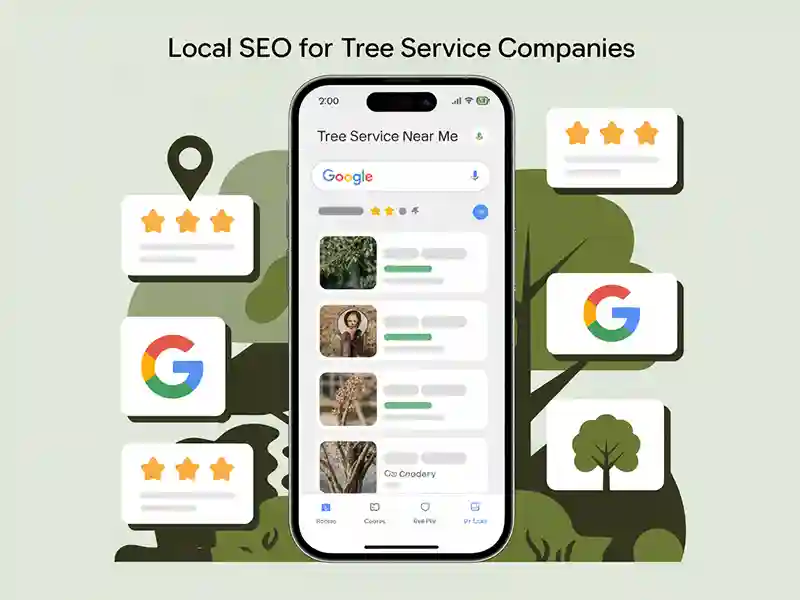
Your Google Business Profile is the map listing that shows up when someone searches for tree services. Those three businesses at the top of the search page with the map. If you’re not one of those three, you basically don’t exist.
Setting it up takes five minutes. Most tree companies stop there. Big mistake.
Here’s what actually matters. You need to verify your listing, which means Google mails you a postcard with a code. Annoying but necessary. Then you fill out everything. And I mean everything. Business hours, service area, phone number, website, photos, services, business description.
The description is where most people blow it. They write something like “We are a professional tree service company providing quality work since 2005.” Google doesn’t care. Customers don’t care. Write something useful. “We handle tree removal, trimming, stump grinding, and emergency storm cleanup in Springfield and surrounding areas. Licensed and insured with ISA certified arborists on staff.”
Photos matter more than you’d think. We’ve tested this. A profile with 20+ photos of actual work – crews cutting trees, equipment, finished jobs – gets way more clicks than one with three blurry pictures. People want to see what you do before they call.
Then you have to keep it updated. Post photos when you finish jobs. Answer questions people leave on your profile. Update your hours if they change. Google tracks this stuff. Active profiles rank better than abandoned ones. One of our clients posts a photo every single week. Just pulls one from his phone, writes two sentences about the job, posts it. Takes three minutes. His profile ranks in the top spot for eight different tree service searches in his area.
Most tree companies set this up once and forget it exists. Then they complain that SEO doesn’t work. It works. You’re just not actually doing it.
Google uses reviews to figure out if you’re trustworthy. A tree company with 50 reviews and a 4.7 rating beats one with 8 reviews and a perfect 5.0 every time. Volume matters. Recency matters.
The problem is most tree service owners feel weird asking for reviews. I get it. You did the job, you got paid, asking for more feels like you’re begging. But you’re not. You’re giving happy customers a way to help you out, and most of them are fine with it if you make it easy.
Here’s what works. Right after you finish a job and the customer says they’re happy, you say something like “Hey, if you’ve got a minute later, a Google review really helps us out. I can text you a link that makes it easy.” Most people say yes. Then you actually send the link. Most tree guys say they’ll do this and then forget.
We set up a system for our clients where they get a text template they can use. Takes 30 seconds to send. The link goes straight to their Google review page. Customer clicks, writes two sentences, done. You’d be surprised how many people actually do it when you make it that simple.
Bad reviews happen. Had a client freak out over a one-star review from a lady who said his crew was rude. He wanted to argue with her in the response. Bad idea. We had him write something like “We’re sorry you had that experience. That’s not how we train our crews to act. I’d like to make this right – please call me directly at [number].” Professional. Calm. Shows future customers that he handles problems like an adult.
Funny thing is, that response probably got him more business than ten five-star reviews would have. People read that stuff.
This one’s boring but it screws people up all the time. Your business name, address, and phone number need to be identical everywhere they appear online. Everywhere. Your website, your Google listing, Yelp, Facebook, Angie’s List, wherever.
If your website says “Bob’s Tree Service LLC” but your Google profile says “Bob’s Tree Service” and your Yelp page says “Bobs Tree Service” without the apostrophe, Google gets confused. Confused Google doesn’t rank you well.
Same with addresses. If you abbreviated “Street” as “St.” in one place and spelled it out in another place, that’s a problem. If your suite number is on some listings but not others, that’s a problem.
I know this sounds picky. It is picky. Google’s robots are picky.
We do audits for new clients and find this stuff constantly. Guy had his old phone number on six different directory sites because he changed numbers three years ago and never updated them. Another client had two different addresses – his home office and his shop – listed in different places. Google didn’t know which one was real, so it didn’t rank him for either location.
Fix this once and you’re done. Go through every directory you can find where your business is listed. Make sure everything matches exactly. Same format. Same punctuation. Same everything. It’s tedious but it matters.
If you serve more than one town, you need separate pages for each place. Not a list of cities on your homepage. Real pages with real content.
Here’s what doesn’t work. A page that says “Tree Service in Springfield!” with two sentences of nothing. Google sees through that immediately. We call those doorway pages and Google hates them.
What works is writing actual useful content about tree services in that specific area. Talk about the trees that grow there. Common problems homeowners have. Services that are popular in that region.
Example. We built a page for a client who serves Boise. Instead of generic tree service stuff, we wrote about the ash trees and maples that are common there, the borers that attack them, when to prune in Boise’s climate, what storm damage looks like after those summer microbursts they get. Real information someone in Boise would actually find useful.
That page ranks in the top three for “tree service Boise” and about ten related searches. It brings in jobs every single week. The page is maybe 800 words. Took a couple hours to write. That’s it.
Include your business name, address, and phone number on each location page. Add a Google Map. Make it obvious you actually serve that area. Google wants proof you’re not just keyword stuffing.
If you serve five towns, you need five pages. If you serve twenty, well, you’ve got work to do. But don’t skip this. Location pages are how you rank for searches in multiple areas.
You can’t rank for “tree removal” nationally. That search gets millions of results and the big companies with huge budgets own it. You don’t want to rank for that anyway because some guy in Florida searching for tree removal doesn’t help you if you’re in Oregon.
You want “tree removal Portland” or “emergency tree service Multnomah County” or “stump grinding near Beaverton.” Specific. Local. That’s what people actually search when they need help.
Use those phrases naturally in your content. Put them in your page titles. Use them in your headings. Write them into your service descriptions. But don’t be weird about it. Don’t write “tree removal Springfield tree service Springfield” fifteen times on one page. Google’s smarter than that and it looks stupid to customers.
The longer, more specific phrases work better for tree companies anyway. “Affordable oak tree removal in west Denver” has less competition than “tree removal Denver” and the person searching that is way more likely to call you. They know what they want. They know where they are. They’re ready to hire someone.
We track this for our clients. The generic short keywords get searched more but convert worse. The longer specific ones bring in customers who are actually ready to book work. Focus on those.
Links from other websites tell Google you’re legitimate. Not just any links. Local links from real businesses and organizations in your area.
This doesn’t mean submitting your business to 500 directories you’ve never heard of. That doesn’t help and might hurt. What helps is real links from real sources.
Join your local chamber of commerce. They usually list members on their website with a link. Sponsor a little league team or a community event and get mentioned on their site. Partner with local landscapers or property management companies and get listed on their resources page.
One of our clients does all the tree work for a property management company that handles 200+ rental properties. Got a link from their vendor page. That one link probably brings him more business than 50 random directory submissions would.
Local news sites are gold if you can get them. After a big storm, we had a client reach out to the local paper and offer to give them expert quotes about tree safety and storm damage. They quoted him in an article and linked to his site. That helped his rankings and brought in direct calls from people who read the article.
Don’t buy links. Don’t trade links with random sites. Don’t use those services that promise 1000 backlinks for $99. Google sees through all that and it can actually hurt your rankings.
Most people searching for tree services are on their phones. They’re standing in their yard looking at a tree that just cracked, or they’re at work and saw a branch hanging over their house on their lunch break. They pull out their phone and search.
If your website doesn’t load fast on mobile or it’s hard to use, they’re gone. They hit the back button and call the next company. You don’t even know you lost them.
Google knows this too and prioritizes mobile-friendly sites in search results. If your site takes 10 seconds to load on a phone or the text is too small to read or the buttons don’t work, Google drops you down the rankings.
Test your site on your own phone. Can you easily tap the phone number to call? Can you read everything without zooming in? Does it load in under three seconds? If not, you’ve got problems.
We’ve rebuilt sites for clients where the old site looked fine on a desktop but was completely broken on mobile. After fixing it, their calls went up 40% in the first month. Same SEO. Same rankings. Just a site that actually worked when people found it.
This isn’t optional anymore. If your site doesn’t work on phones, you’re losing jobs every single day.
The biggest one is not doing anything. Just ignoring the whole thing and hoping word of mouth carries them forever. It won’t.
Second biggest is doing it halfway. Setting up a Google profile three years ago and never touching it again. Writing one blog post in 2019 and calling it content marketing. Starting to ask for reviews and then forgetting about it after two weeks.
We had a client come to us who’d been working with another SEO company for a year. They’d paid them $800 a month and seen zero results. Know what the problem was? The SEO company never actually set up his Google Business Profile correctly. It was claimed but not verified. Twelve months of paying someone and the most basic thing wasn’t even done right.
Another common one is keyword stuffing. Guys write “tree removal services tree trimming tree cutting tree pruning” all over their homepage because they think that’s SEO. It’s not. It’s annoying to read and Google ignores it.
Having different phone numbers or addresses in different places is huge. We found a client with three different phone numbers across his listings because he’d changed numbers twice and never cleaned up the old ones. Google didn’t know which business was actually him.
Trying to rank for every city within 100 miles is another mistake. Focus on your actual service area first. Get strong rankings there. Then expand. Trying to do too much at once means you do nothing well.
Not tracking anything is the other big one. You can’t improve what you don’t measure. If you don’t know how many people find your site from Google, how many call, or which pages they look at, you’re guessing. Install Google Analytics. Check it monthly. Make decisions based on data, not feelings.
You stay invisible. People search for tree services in your town and see your competitors. They call your competitors. You never even know the lead existed.
We tracked this for a client before we started working with him. He was getting maybe one or two calls a week from his website. Meanwhile another tree company in the same town with worse reviews and higher prices was getting 15-20 calls a week just because they ranked better. Same market. Same services. The only difference was one showed up and one didn’t.
You end up completely dependent on referrals. Which is fine when they’re coming in steady. But what happens when your best referral source retires? Or moves? Or starts using someone else? You’re stuck. No backup plan. No other way to get work.
I’ve seen companies go under because of this. Good companies with solid crews and years of experience. They just couldn’t adapt when their referral pipeline dried up. They’d spent 20 years relying on word of mouth and never built any other way to get customers. When the phone stopped ringing, they had nothing.
The other thing is you end up competing on price. When you’re not the one customers find first, you have to find them. That usually means sites like HomeAdvisor or Angie’s List where you’re bidding against six other companies for the same lead. Those platforms take a cut. Customers expect lower prices because they’re comparing quotes. You make less money on every job.
Companies with good SEO don’t have to do that. They get direct calls from their website. No middleman. No bidding wars. Customer already saw their site and reviews and decided to call them specifically. Way better position to be in.
Look, we get it. You’re running a tree company. You’ve got crews to manage, equipment to maintain, estimates to write, jobs to schedule. The last thing you have time for is figuring out Google algorithms and updating your business listings.
That’s what we do at Tree Service Marketing Solutions. We’ve been handling local SEO specifically for tree companies for over ten years. Not general contractors. Not landscapers. Tree services. We know this industry.
We know what keywords actually bring in jobs versus which ones just waste your time. We know how to write content about tree work that ranks well and sounds like it was written by someone who actually knows trees, not some content mill overseas. We know which directories matter and which ones are garbage.
When we take on a client, we start with an audit. Figure out what’s broken. Usually it’s a lot. Google profile not optimized. Business info inconsistent across 15 different sites. Website that doesn’t work on phones. No system for getting reviews. Location pages that are basically spam.
Then we fix it. We set up your Google Business Profile correctly. We clean up all your citations so everything matches. We write actual useful content for your location pages. We set up systems for getting reviews. We build your site so it actually works and converts visitors into calls.
And we track everything. You get monthly reports showing exactly where your calls are coming from, which pages are working, what’s ranking, and where we need to adjust.
Our clients stay with us because it works. They’re not wondering where the next job is coming from. They’re not scrambling during slow seasons. They’ve got leads coming in consistently from Google, and they know it’s because their local SEO is dialed in.
If you want to talk about your specific situation and what needs to happen to fix it, contact us for a free consultation. We’ll look at what you’re currently doing, show you where you’re losing business, and lay out exactly what needs to change. No pressure. No sales pitch. Just honest advice from people who do this every day for tree companies just like yours.
Don’t wait until next winter when you’re broke and desperate. Get this handled now while you’re busy and you’ve got cash flow. By the time things slow down, you’ll have a steady stream of leads keeping you and your crew working.