
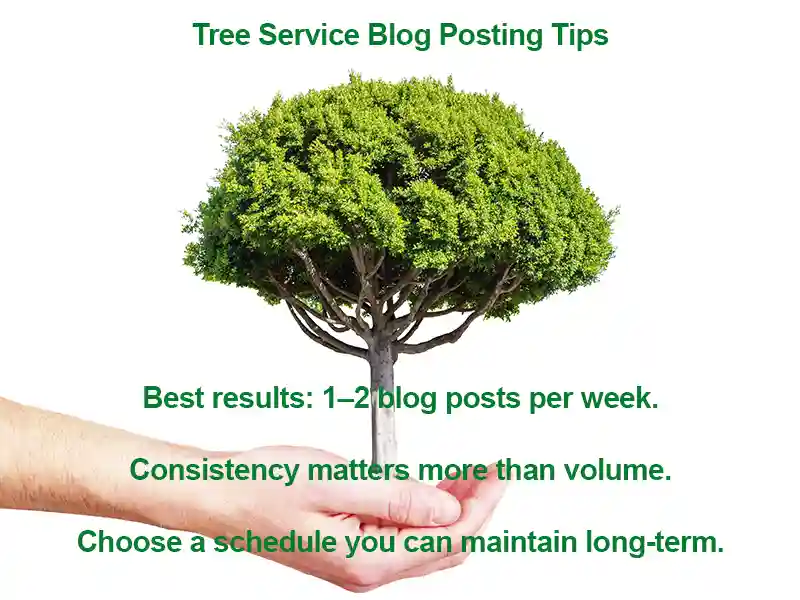
Most tree companies should post blog content weekly or twice per month. Daily posting is overkill and unsustainable for small businesses. Monthly posting is too infrequent to build momentum or see SEO benefits. The sweet spot for tree services is 1-2 quality blog posts per week or 4-8 posts per month depending on your resources and goals.
We’ve managed content strategies for tree service companies for over a decade. We know what posting frequency actually works versus what sounds good in theory but burns people out in practice. Most tree companies try daily posting for two weeks, realize they’re running a tree company not a publishing house, and quit completely. That helps nobody.
Here’s what actually matters – consistency over volume. Posting once per week every single week for a year beats posting daily for a month then nothing for six months. Google rewards consistent fresh content. Customers see you’re active and current. Your SEO improves gradually over time.
Google algorithms look at how often you update your site. Websites that add new content regularly get crawled more frequently. More crawls mean faster indexing of new pages. Fresh content signals your business is active and relevant.
But here’s the thing most SEO advice gets wrong. They tell every business to post daily. That makes sense for news sites or large companies with content teams. It doesn’t make sense for a tree service with 5-10 employees where the owner is also running crews and doing estimates.
We tracked posting frequency versus SEO results across 40+ tree service clients. Companies posting 1-2 times per week saw steady traffic growth. Companies trying to post daily burned out within a month and their traffic stayed flat. Companies posting monthly saw minimal movement. The weekly posters won every time because they were the only ones who sustained it.
Posting frequency also affects your content calendar and planning. If you’re trying to post daily, you’re constantly scrambling for topics. If you’re posting weekly, you can plan a month ahead and batch your writing. Way more sustainable.
Daily posting means 7 blog posts per week. 30 per month. 365 per year. That’s a full-time job just creating content. Unless you’ve hired someone specifically to run your content marketing, you’re not doing this consistently.
The only tree companies we’ve seen sustain daily posting either hired a full-time marketing person or outsourced to a content agency. Even then, the ROI is questionable because you hit diminishing returns fast.
Think about your audience. Homeowners who need tree work aren’t checking your blog daily for new content. They’re not blog subscribers eagerly awaiting your next post. They find you when they have a tree problem, read a few relevant articles, and either call you or don’t.
Publishing 7 mediocre posts per week helps less than publishing 1-2 really useful posts. Quality matters more than quantity for local service businesses.
When daily posting might make sense: You’re a large tree service doing commercial work across multiple states, you have a full-time marketing person, and you’re using content as your primary lead generation strategy. For 99% of tree companies, this doesn’t apply.
One blog post per week is 52 posts per year. That’s enough to build real SEO momentum without burning out. You can plan these monthly. Batch write them. Schedule them in advance. It’s manageable even for busy tree company owners.
Weekly blog posting schedules gives you enough frequency for Google to see you’re active without overwhelming your team. It gives customers enough new content to show you’re current without them feeling spammed. And it’s enough volume to cover your important topics over time.
We set up most clients on weekly schedules. Tuesday or Wednesday posting works well because it avoids weekend/Monday chaos. Pick a day, stick to it. Consistency matters more than which specific day.
A weekly schedule lets you cover different content types systematically. Week 1 might be a service page topic like “How Much Does Tree Removal Cost.” Week 2 might be seasonal content like “Spring Tree Pruning Guide.” Week 3 might be a common question like “When to Remove vs Trim a Tree.” Week 4 might be local content like “Common Trees in [Your City] and Their Care Needs.”
The pattern keeps content varied and useful while being totally manageable. We’ve had clients maintain weekly posting for 3-4 years straight. That’s 150-200 quality blog posts. That’s real SEO value and real content that helps customers.
Two posts per week is 104 posts per year. Double the content, potentially better SEO results, but also double the work.
This works for tree companies who’ve been posting weekly for 6+ months and want to accelerate. You’ve got your systems down. You know your topics. You have content ideas queued up. Adding a second weekly post is manageable.
It also works if you have someone on staff who can write or you’re outsourcing content creation. Expecting a busy owner to write two quality posts per week on top of running the business is unrealistic.
We have maybe 20% of clients on twice-weekly schedules. Usually larger companies doing $2M+ annually who have marketing help. They see faster SEO growth than weekly posters but not double the growth. Diminishing returns kick in.
Two posts per week lets you hit more keywords, cover more topics, and dominate local search faster. But it’s only worth it if you can sustain the quality. Two mediocre rushed posts aren’t better than one good post.
Every other week is 26 posts per year. Half the volume of weekly posting. This is the minimum frequency we recommend for tree companies serious about content marketing.
Biweekly works for brand new companies building their first content library. You’re getting comfortable with writing, figuring out your voice, learning what topics resonate. Starting with every other week is less overwhelming than jumping to weekly.
It also works for small companies where the owner is doing everything and genuinely doesn’t have time for weekly posts. Biweekly is better than monthly and way better than nothing.
But understand the tradeoff. SEO momentum builds slower. Your content library grows slower. Customers don’t see updates as frequently. If you can possibly manage weekly, do weekly. If not, biweekly is acceptable.
We usually start new clients biweekly for 2-3 months, then move to weekly once they’re comfortable with the process. It’s a stepping stone not a long-term strategy.
One post per month is 12 posts per year. That’s enough to avoid looking completely abandoned but not enough to build real SEO momentum or cover your important topics in any reasonable timeframe.
Monthly posting takes years to see significant results. You’ll publish maybe 30-40 posts before you notice meaningful traffic increases. That’s 3-4 years. Weekly posting gets you there in under a year.
The only tree companies we put on monthly schedules are ones who absolutely cannot commit to more. Maybe they’re solo operators doing everything themselves. Maybe they’re in a very small market with limited topics. Maybe they’re testing content marketing before committing more resources.
Monthly is better than nothing. If your choice is monthly posting or no posting, choose monthly. But know it’s the slow path and results will take years not months.
This is the most important point. Posting weekly for 6 months straight beats posting twice weekly for 6 weeks then nothing for 4 months.
Google rewards consistent publishing patterns. If you post every Tuesday for months, Google learns to crawl your site every Tuesday. If you post randomly whenever you remember, Google checks less frequently and your content gets indexed slower.
Readers subconsciously notice consistency too. If they see your business updates your blog regularly, you seem active and professional. If your last post is from 8 months ago, you look neglected or potentially out of business.
Pick a frequency you can actually maintain for 12+ months. Don’t pick twice weekly because it sounds ambitious if you’ll burn out in a month. Pick weekly or biweekly, stick to it, and build from there.
We’ve had clients maintain weekly posting for 3+ years. That consistency compounds. Every new post adds SEO value. Old posts continue ranking and bringing traffic. The cumulative effect is powerful but only if you sustain it.
Batch your content creation. Don’t write one post the night before it needs to publish. Set aside 3-4 hours once per month, write 4-5 posts, schedule them. Done for the month.
Use a content calendar. Plan your topics monthly or quarterly. Know what you’re writing about before you sit down to write. No more staring at a blank screen wondering what to write.
Keep a running list of content ideas. When you’re on a job and a customer asks a good question, write it down. That’s a blog post topic. When you see seasonal issues, note them. You’ll never run out of ideas.
Repurpose content from other sources. Turn your FAQ into blog posts. Expand on social media posts. Use customer questions as topics. You don’t need to invent everything from scratch.
If you can’t write, hire someone or use a service. Trying to force yourself to write when you hate writing guarantees you’ll quit. Outsource it and focus on running your tree business.
Starting too ambitious. “We’re posting daily!” Two weeks later they’re done. Start with what’s sustainable.
Inconsistent posting. Active for a month, silent for three months, active again. Kills your momentum and SEO benefits.
Sacrificing quality for quantity. Publishing garbage just to hit a quota. One good post beats three bad ones.
No content calendar. Winging it every week leads to writer’s block and stress.
Writing what you want to write instead of what customers want to read. Your post about the history of chainsaws won’t help SEO. “When to Remove a Dangerous Tree” will.
Not optimizing posts for SEO. Writing content without targeting keywords or adding proper headings means you miss the SEO benefits.
Giving up too soon. Content marketing takes 6-12 months to show results. Most tree companies quit after 2 months.
We put most tree service clients on weekly blog posting schedules as part of our tree service social media strategy. It’s the sweet spot between results and sustainability. Some larger clients do twice weekly. Some smaller ones start biweekly and move to weekly.
We handle all the content creation. Research keywords, write posts, optimize for SEO, schedule publishing. Clients approve topics monthly but don’t write anything themselves.
We build content calendars 3 months ahead. Clients know what’s coming. No surprises. No scrambling. Just consistent publishing on schedule.
We track results monthly. Show clients what content is ranking, bringing traffic, and generating leads. Adjust topics based on performance data.
Most clients start seeing SEO improvements within 4-6 months. Traffic increases. Rankings improve for target keywords. Leads start coming from blog content. But only because we’re posting consistently week after week.
If you want blog content handled professionally without doing it yourself, contact us. We’ll figure out the right posting frequency for your goals and resources, create content that actually ranks and helps customers, and maintain the schedule indefinitely.
The best posting schedule is whichever one you’ll actually maintain long-term. For most tree companies, that’s weekly. Start there, stay consistent, and build from there as results justify more investment. Consistency beats frequency every single time.